Premium quality marine components, vessels, and energy solutions designed for demanding industrial applications.
How commercial marine acoustic instrumentation is shifting toward multi-frequency digital signal processing and IoT integration.
Traditional single-frequency echo sounders are rapidly yielding ground to Compressed High-Intensity Radiated Pulse (CHIRP) arrays. By transmitting a swept-frequency range rather than a single pulse, modern systems deliver superior target resolution, clearer bottom contours, and minimal signal clutter, enabling precise navigation in congested or shallow channels.
Modern commercial vessels require seamless interoperability. Next-generation transducers operate natively with NMEA 2000 networks and Modbus interfaces. Real-time bathymetric data can be transmitted to ship management platforms via cloud connections, enabling real-time mapping updates and predictive predictive maintenance for hull performance.
Deep-sea operators rely on intelligent algorithm architectures to interpret seabed compositions automatically. Advanced depth sounders process echo returns in real-time, distinguishing soft mud from hard bedrock, and filtering out biological interference to guarantee absolute accuracy in automated pilot systems.
Developing highly reliable maritime equipment requires specialized acoustic engineering, precise material sourcing, and standardized construction processes. At the heart of our operations lies a fundamental commitment: performance is defined by operational resilience under extreme marine environments.
By coordinating design expertise with US engineering principles and veteran German hull architects such as Klaus Filter and Graeme King, alongside the production infrastructure of Flying Eagle Boat Company, we deliver marine structures and echo sounder components that redefine industry standards for longevity and precision. Whether crafting racing shells or sourcing deep-water sounding sensors, we integrate the absolute finest in physical materials and signal processing.

Deciphering the rigorous technical standards demanded by commercial operators, port authorities, and naval procurers.
Ultra-deep shipping vessels and container fleets require heavy-duty depth sounders that conform to IMO (International Maritime Organization) regulations. Procurers look for dual-frequency transducers (typically 50 kHz and 200 kHz) to verify depth clearings under the keel, even in thick silt environments typical of major commercial shipping canals.
Dredging operations require high-precision acoustic transducers that can map bottom topography before and after sediment clearing. Suppliers must deliver robust equipment capable of surviving continuous abrasive contact and cavitation forces without signal degradation or structural cracking.
Patrol, pilot, and coast guard ships require shock-resistant, low-signature hydroacoustic sounders. Compliance with MIL-STD standards, extreme waterproofing (IP68), and integration with onboard navigational systems like ECDIS (Electronic Chart Display and Information System) are non-negotiable requirements for government contracts.

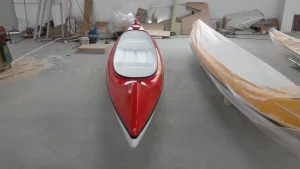
Our capabilities go far beyond manufacturing individual components. Just as WinTech Racing and Green provide complete racing shell solutions, we support marine networks with comprehensive hardware, electrical arrays, and accessories. Our product eco-system includes coaching launches, specialty trailers, customized oars, and a full catalog of spare parts designed to work in synergy with modern hydroacoustic arrays.
Leveraging advanced manufacturing clusters, structural automation, and raw material access to secure high-performance marine technology.
Every echo sounder sensor undergoes pressure, calibration, and vibration testing in temperature-controlled deep-water simulator tanks.
Utilization of advanced piezoelectric ceramics secures near-instant signal response times and optimal acoustic conversions.
State-of-the-art robotic production lines guarantee design uniformity across all batches of high-strength fiberglass, aluminum hulls, and microelectronics.
Operating out of highly centralized logistics hubs, our production plants ensure that custom modifications—such as custom transducer casings, varied cable lengths, and specialized electrical protocols—can be integrated without disrupting shipping schedules. By sourcing premium grade raw materials (such as marine-grade polyurethane, corrosion-resistant bronze, and high-purity silicon) directly from integrated domestic steel and component mills, we shield international commercial buyers from supply chain shocks.
Adapting depth sounding and marine acoustics to distinct environmental and geographic challenges.
Navigating cold polar waters demands specialized transceivers. Sub-zero environments require transducers constructed with specialized low-temperature acoustic windows that resist cracking and can propagate ultrasound waves efficiently through slush and heavy ice density variations.
Estuaries and river mouths exhibit massive sediment loads. Depth sounders deployed in these settings utilize high frequencies (200 kHz or higher) coupled with advanced signal filtering to prevent backscatter reflections from suspended sand particles, ensuring pilot boats avoid sandbanks.
Deep-sea exploration demands low-frequency power output (28–38 kHz) capable of penetrating kilometers of the water column to map deep ocean trenches. The structural assembly of these transducers requires specialized oil-filled casings to withstand massive hydrostatic pressures.
Essential insights for professional marine equipment buyers and procurement managers.
Discover additional components, protective accessories, and recreation hardware in our wholesale catalog.

 Green Boat